
Corning Museum of Glass
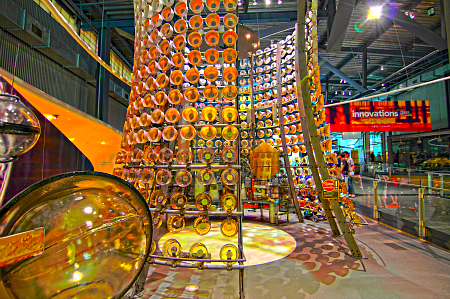
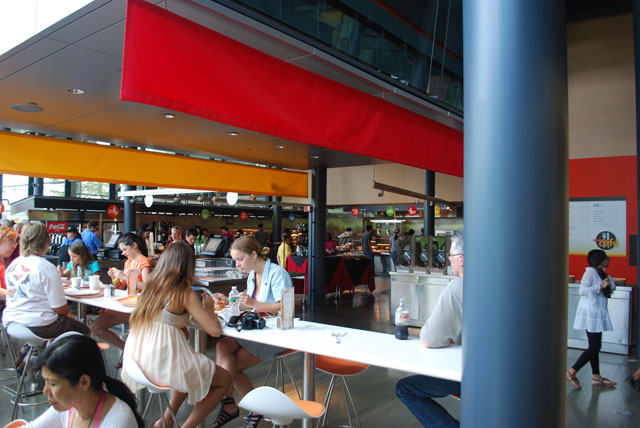
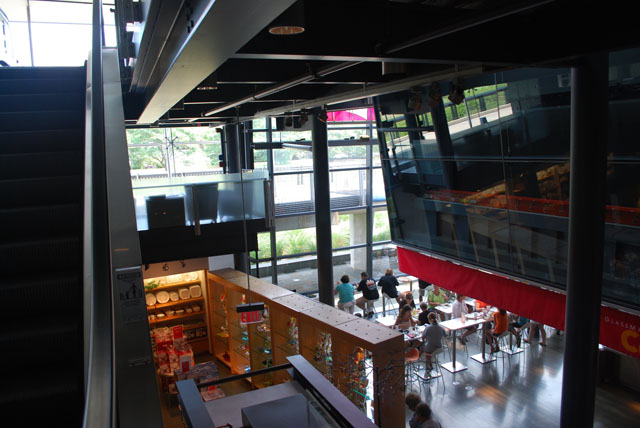
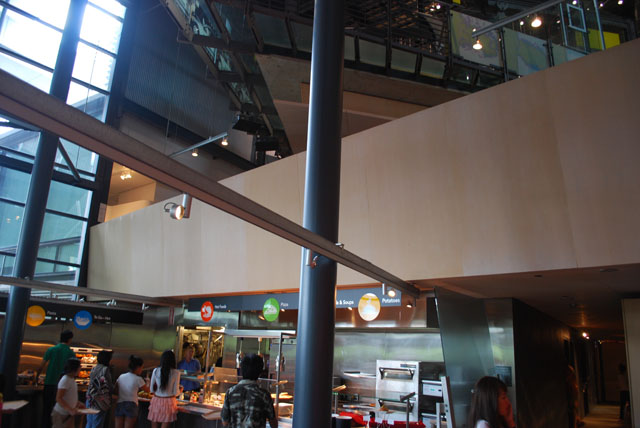
This is, of course, stating the obvious but, being a museum of glass, Corning Museum of Glass has a lot of glass!
Here is why that is a big deal: environments filled with glass are among the hardest spaces to control acoustically. Since glass is smooth, rigid, and non-porous, it reflects up to 90% of sound energy. When this happens, it creates severe reverberation, disruptive echoes, and booming background noise, while its low mass allows outside noise to easily penetrate the space.
When this particular expansion project was undertaken to add a restaurant and store area, the museum decided to take measures to reduce sound level in this busy venue. While there are many glass surfaces, thankfully there were also surfaces that could be treated.
Field testing was performed to verify existing conditions. A computer model was implemented to verify the results possible by treating the surfaces that could be treated. The design target was to achieve a reverberation reduction of 4 seconds. Wall surfaces, ceiling areas, and other solid surfaces were treated with acoustically absorbent materials that mimic the look of standard materials.
Decorative banners were also added to absorb even more sound. While the space is still live (after all, it still has a lot of glass!) the overall reverberation has been reduced significantly.
Related Projects



Corning Museum of Glass
This is, of course, stating the obvious but, being a museum of glass, Corning Museum of Glass has a lot of glass!
Here is why that is a big deal: environments filled with glass are among the hardest spaces to control acoustically. Since glass is smooth, rigid, and non-porous, it reflects up to 90% of sound energy. When this happens, it creates severe reverberation, disruptive echoes, and booming background noise, while its low mass allows outside noise to easily penetrate the space.
When this particular expansion project was undertaken to add a restaurant and store area, the museum decided to take measures to reduce sound level in this busy venue. While there are many glass surfaces, thankfully there were also surfaces that could be treated.
Field testing was performed to verify existing conditions. A computer model was implemented to verify the results possible by treating the surfaces that could be treated. The design target was to achieve a reverberation reduction of 4 seconds. Wall surfaces, ceiling areas, and other solid surfaces were treated with acoustically absorbent materials that mimic the look of standard materials.
Decorative banners were also added to absorb even more sound. While the space is still live (after all, it still has a lot of glass!) the overall reverberation has been reduced significantly.